

There’s a specific kind of silence that falls over a player staring at a 13% chance. They know the odds are bad. They know they could wait and spend the money somewhere safer. And they press the button anyway.
That moment is the reason RNG has crept into so many incremental games. The genre started out as pure arithmetic: buy a thing, earn more, buy a bigger thing. Random chance looks like it doesn’t belong there. But anyone who has spent an evening chasing one more star knows it does something the arithmetic alone can’t.
Instead of talking about luck in vague terms, let’s put real numbers on it. The example here is Spacebar Clicker (https://idlespacebar.com/), a free retro-style clicker in your browser that publishes every one of its odds on screen. That makes it a rare case where you can actually do the math on how lucky you need to be.
Where the randomness lives
Most of Spacebar Clicker is perfectly predictable. You press the space bar, money goes up. You buy phones, laptops, PCs, servers and mining rigs, and level up their parts one at a time. Each level costs 27% more than the one before and adds 10% more than the one before. Given enough time, you could chart your entire income curve on paper.
Randomness only shows up at the edges, at three specific points:
- Enhance, a paid roll on a part you’ve already maxed out.
- Rig crits, free bonus payouts on mining rigs.
- Click Boost, a timing minigame where the uncertainty is your own hands.
That placement matters. The core loop stays reliable, so you always feel in control of your progress. The luck sits on top, as a place to push when the safe options start to feel routine.
Eleven stars, eleven different odds
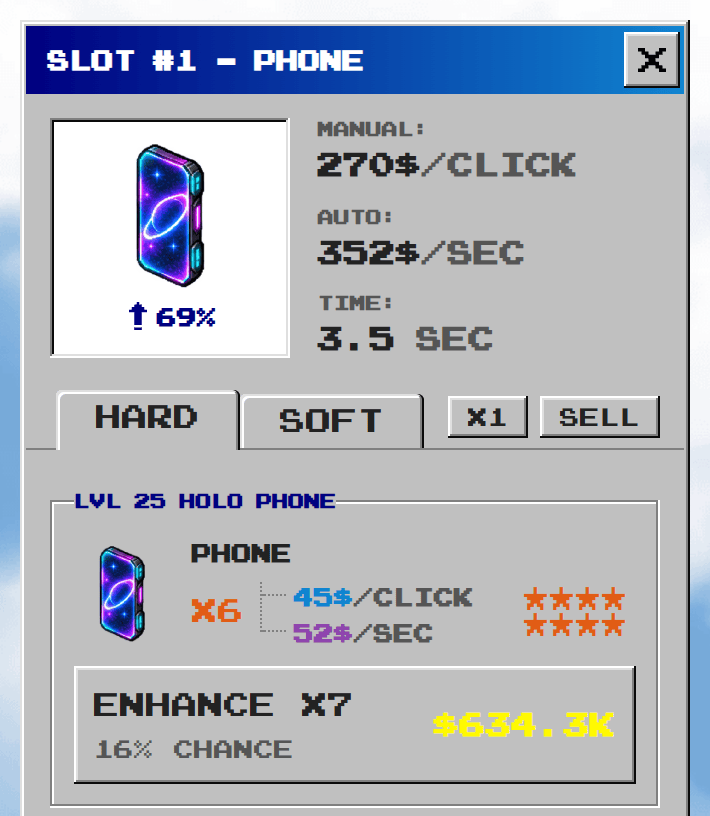
Enhance appears once a part reaches its maximum level. A phone, for example, tops out at level 25. From there, the only way to make it stronger is to roll for stars. Every star multiplies everything that part earns, both per click and per second.
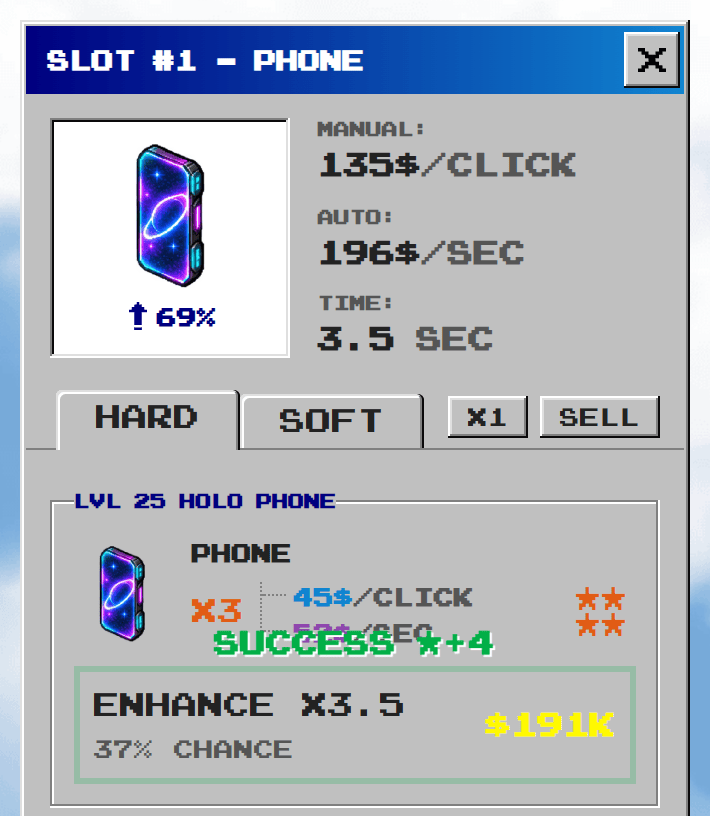
The first star is almost free money: a 90% chance. After that, the odds fall with every step. Here’s the full ladder, along with the number of attempts you’d need on average to clear each step. That average is simply one divided by the chance.
| Star | Chance | Average attempts | Part multiplier |
|---|---|---|---|
| 1 | 90% | 1.1 | x1.5 |
| 2 | 73% | 1.4 | x2 |
| 3 | 60% | 1.7 | x2.5 |
| 4 | 48% | 2.1 | x3 |
| 5 | 37% | 2.7 | x3.5 |
| 6 | 30% | 3.3 | x4 |
| 7 | 25% | 4 | x5 |
| 8 | 20% | 5 | x6 |
| 9 | 16% | 6.3 | x7 |
| 10 | 13% | 7.7 | x8 |
| 11 | 10% | 10 | x10 |
Add the middle column up and you get about 45 attempts to take one part from zero to eleven stars. That’s the average, not a promise. Some players will get there in thirty. Some will need seventy. That spread is exactly where the drama comes from.
The price tag nobody notices at first
Attempts aren’t free, and they get more expensive as you climb. Each roll costs 1.75 times the price of the part’s last regular level, and that grows by another 35% with every star you already hold. So a roll for the first star costs 1.75 times the last level, a roll for the fifth star about 5.8 times, and a roll for the eleventh star about 35 times.
Combine rising prices with falling odds and the total picture becomes clear. On average, the eleventh star alone costs around 350 times the part’s last level price, while the first star costs about 2 times. Taking one part all the way to eleven stars works out to roughly 850 times that last level price in total, with more than 40% of it spent on the final star.
This is a well-built curve. The early stars are cheap and almost certain, so every player gets to feel the system working. The late stars are expensive and rare, so they become long-term goals instead of something you finish in an afternoon. A x10 part isn’t something you stumble into. It’s a project.
The safety net that keeps you rolling
The scariest version of upgrade RNG is the kind where failure takes something away. Lots of games have used it: fail a roll and your item drops a level, or breaks entirely. It creates big emotions, but mostly bad ones, and it teaches players to stop taking risks at all.

Spacebar Clicker goes the other way. A failed Enhance costs the money you spent on that one attempt, and nothing else. Your stars stay. Your multiplier stays. That one rule changes how the whole system feels. A bad streak is annoying, but it never undoes hours of play, so you’re always willing to try again once your income refills.
On top of that, every attempt carries a 5% chance to crit and jump two stars at once. Statistically it’s a small boost. Emotionally it’s huge, because it means any single roll, even one at 10%, could turn into the best moment of your session.
Luck you don’t pay for
Enhance is luck you choose. The game’s mining rigs offer the opposite: luck that just happens. A Miner in Spacebar Clicker is filled with cards, and your first card decides whether it’s a GPU rig or a CPU rig. Every production cycle has a chance to crit. On a GPU rig it’s 3% for x1.5. On a CPU rig it’s 8% for x2.
Do the expected-value math and the difference is clear. A 3% chance of x1.5 adds about 1.5% to a GPU rig’s income on average. An 8% chance of x2 adds about 8% to a CPU rig’s. So CPU rigs lean much harder on luck, while GPU rigs get their edge elsewhere: stronger cards and a sync bonus that’s twice as large per card when you keep their levels together.

Free luck like this works differently in your head. It doesn’t create tension, because you never risk anything. What it creates is texture. Most cycles pay out the usual amount, then one suddenly pays more, and your eye catches it. It makes a passive income stream feel a little bit alive.
When the dice are your fingers
The third kind of uncertainty isn’t random at all, but it plays on the same nerves. Hold the space bar in Spacebar Clicker and you enter Click Boost: a needle sweeps across a bar, and you press to stop it inside a target zone.
The multiplier starts at x3. Every hit multiplies it again by 1.2 to 1.39, up to a cap of x2000. Every miss costs one of three hearts. And after each hit the needle speeds up and the zone shrinks, so the longer your streak, the harder the next press.
Run the numbers and you can see why the cap feels so far away. Even at the best factor every time, getting from x3 to x2000 takes about twenty clean hits in a row against a zone that keeps shrinking. It’s a target that rewards practice, and one most players will chase across many sessions rather than reach on day one.
Skill-based risk has one big advantage over dice: when it goes well, you get the credit. A lucky Enhance crit feels like the universe smiled at you. A twenty-hit boost streak feels like you did it yourself.
Why the odds are on screen
One detail ties all of this together: Spacebar Clicker shows you the numbers. Every Enhance button lists its chance and price before you click. Rig crit rates and payouts are known values. Click Boost shows your multiplier and hearts live.
That transparency is what keeps RNG fun rather than frustrating. When the odds are hidden, every failure feels like the game cheating. When they’re visible, a failure is just a 52% outcome that happened, and you go in again knowing exactly what you’re facing. Good incremental games treat luck as something to plan around, not something to hide.
How RNG stretches a game’s life
The quiet problem of a purely predictable incremental game is that it eventually runs out of decisions. Once you know the optimal purchase every time, you’re just following a list.
RNG breaks that list. Should you roll for a ninth star now, or buy another server? Is a CPU rig’s luck worth more than a GPU rig’s sync bonus? Do you go for a boost streak now, or wait until your click income is bigger so the payout is worth more? None of these questions has a single right answer, and that keeps you thinking.
More importantly, they turn the late game into a set of long projects. Forty-odd Enhance rolls per part, across dozens of parts. Card slots to open and sync. A boost record to beat. That’s weeks of goals, every one of them with a moment of suspense built in.
If you’re curious how your own luck holds up, it’s easy to test. Open Spacebar Clicker at https://idlespacebar.com/, max out your free starting phone and start rolling. The table above tells you what to expect. Whether you beat the average is up to the dice.